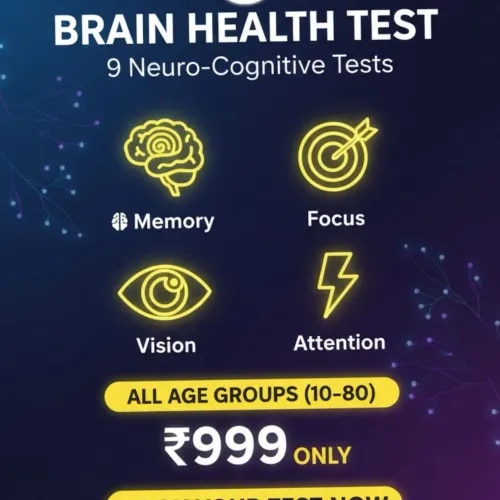
Whole 360° Brain Evaluation Test Profile in Koregaon Park, PuneDr. Prashant Deshmukh | Brain Mind Wellness Clinic, Koregaon Park, PuneThe Whole 360° Brain Evaluation Test Profile is a comprehensive framework for assessing cognitive performance, attention, mental fatigue, emotional regulation, and brain activity. It may combine cognitive assessments, psychological evaluations, clinical history, and Quantitative Electroencephalography (qEEG), depending on the individual's needs.At Brain Mind Wellness Clinic, Koregaon Park, Pune, Dr. Prashant Deshmukh focuses on brain assessment and wellness approaches designed to help individuals better understand their cognitive functioning, attention patterns, and mental well-being.1. Neurocognitive Discriminant Analysis – Brain Fatigue AssessmentUnderstanding Mental Fatigue and Cognitive PerformanceNeurocognitive assessment can help evaluate changes in attention, response speed, accuracy, and mental performance during sustained cognitive tasks. These assessments may help identify patterns of mental fatigue and reduced concentration.Potential Clinical Applications:Assessment of sustained attention and cognitive endurance.Evaluation of difficulties with concentration and mental performance.Monitoring cognitive complaints following a head injury, when clinically appropriate.Identifying individuals who may benefit from further neurological or neuropsychological evaluation.The findings should be interpreted alongside symptoms, medical history, and appropriate clinical examinations.2. Cognitive Analysis – Memory, Attention and Executive FunctionMapping Essential Cognitive SkillsCognitive analysis evaluates important mental functions involved in everyday activities, learning, work, and decision-making.Key areas may include:Working memory and information retention.Sustained attention and concentration.Processing speed and reaction time.Executive functioning and problem-solving.Cognitive flexibility and adaptation to changing situations.Potential Clinical Applications:Cognitive assessments can help characterize difficulties with memory, attention, planning, and decision-making. Depending on the findings, further evaluation may be recommended to investigate possible contributing factors, including sleep difficulties, stress, mood disorders, medication effects, or neurological conditions.Cognitive test results alone cannot establish a diagnosis of dementia, depression, ADHD, or a metabolic disorder.3. Emotional Analysis – Emotional Regulation and Stress AssessmentUnderstanding Emotional Responses and Self-RegulationEmotional assessment explores how individuals respond to stress, manage emotions, and maintain balanced thinking during challenging situations.Areas of assessment may include:Emotional regulation and stress management.Anxiety-related symptoms and emotional responses.Mood patterns and psychological well-being.Attention and decision-making under stress.The impact of emotional difficulties on daily functioning.Potential Clinical Applications:A structured assessment may help identify emotional and psychological concerns that warrant further evaluation. Psychological screening and clinical interviews can help determine whether additional assessment or professional support may be appropriate.Emotional assessments and qEEG findings should not be used alone to diagnose trauma, anxiety disorders, or depression.4. Brain Arousal States and Quantitative EEG (qEEG) AssessmentUnderstanding Brainwave ActivityQuantitative Electroencephalography (qEEG) involves the digital analysis of electrical activity recorded through an electroencephalogram (EEG). It can provide information about brainwave patterns across different frequency ranges.Commonly analysed frequency bands include:Delta waves: Generally associated with deep sleep and certain neurological states.Theta waves: Associated with drowsiness and various cognitive processes.Alpha waves: Commonly observed during relaxed wakefulness.Beta waves: Often associated with alertness and active cognitive processing.Brain activity varies according to age, alertness, sleep, medication, recording conditions, and other factors. Therefore, an individual brainwave pattern must be interpreted carefully rather than automatically classified as abnormal.Understanding qEEG and Z-ScoresqEEG software can compare selected EEG measurements with an appropriate reference database and express some results as Z-scores. These scores indicate how far a measurement differs statistically from the reference population.Potential Applications:Describing selected patterns of electrical brain activity.Supporting clinical assessment when appropriate.Helping guide further evaluation alongside symptoms and other findings.Providing information that may be considered when planning an individualized brain wellness programme.qEEG is not a standalone diagnostic test for most psychiatric or cognitive conditions. Its clinical usefulness depends on the indication, methodology, reference database, and interpretation by a qualified professional.5. Clinical Assessment and Individualized Therapy PlanningA Multimodal Approach to Brain WellnessA comprehensive assessment may include a review of symptoms, medical history, cognitive testing, psychological screening, and qEEG when clinically indicated.Based on the overall findings, an individualized plan may be considered.Neurofeedback Assessment and TrainingNeurofeedback is a form of biofeedback that uses real-time information about selected brain activity to help individuals practise self-regulation. Training protocols vary according to the system used and the individual's assessment.Potential goals may include supporting attention, relaxation, and self-regulation. Outcomes vary, and evidence differs across conditions; neurofeedback should not be presented as a guaranteed treatment or a replacement for established medical care.Personalized Brain Wellness SupportDepending on individual needs, the assessment process may help identify appropriate next steps, such as:Further cognitive or psychological assessment.Sleep and stress management guidance.Neurofeedback evaluation, where appropriate.Referral to a neurologist, psychiatrist, or other qualified specialist when indicated.Why Consider a Whole 360° Brain Evaluation?A structured brain evaluation may help individuals gain a clearer understanding of their cognitive strengths, areas of difficulty, and potential next steps for professional support.At Brain Mind Wellness Clinic, Koregaon Park, Pune, the assessment approach can be tailored to individual concerns, with the aim of supporting informed decisions about brain health and cognitive wellness.Consultation: Dr. Prashant DeshmukhClinic: Brain Mind Wellness ClinicLocation: Koregaon Park, Pune, Maharashtra, IndiaFor assessment details and suitability, contact the clinic directly.Medical note: The specific tests included in a Whole 360° Brain Evaluation depend on the clinic's actual assessment protocol. qEEG and cognitive testing should be interpreted in context and are not substitutes for a comprehensive medical diagnosis.
READ MORE